
What is taxonomy?
Taxonomy is the branch of biology concerned with the description, naming, and classification of organisms. It provides a framework for organizing diversity by assigning organisms to hierarchical categories such as species, genus, family, order, class, phylum, and kingdom. Scientists group organisms based on shared characteristics to place them within the broader structure of life’s diversity.
Taxonomy of NC Ferns & Lycophytes
The 31 fern and lycophyte species in the natural areas covered by this project belong to:
- 26 Genera
- 13 Families
- 5 Orders
- 2 Classes (Polypodiopsida — ferns and Lycopodiopsida — lycophytes)
- 1 Kingdom (Plantae — plants)
These taxonomic classifications are summarized below.
Kingdom Plantae (Plants)
  └─ Phylum Tracheophyta (Vascular plants)
       ├─ Class Polypodiopsida (Ferns)
       │    ├─ Order Ophioglossales
       │    │    └─ Family Ophioglossaceae (Adder's tongue family)
       │    │         ├─ Genus Botrypus
       │    │         │    └─ Botrypus virginianus
       │    │         ├─ Genus Ophioglossum
       │    │         │    └─ Ophioglossum pycnostichum
       │    │         └─ Genus Sceptridium
       │    │              ├─ Sceptridium biternatum
       │    │              └─ Sceptridium dissectum
       │    ├─ Order Osmundales
       │    │    └─ Family Osmundaceae (Royal fern family)
       │    │         ├─ Genus Osmunda
       │    │         │    ├─ Osmunda claytonia
       │    │         │    └─ Osmunda spectabilis
       │    │         └─ Genus Osmundastrum
       │    │              └─ Osmundastrum cinnamomeum
       │    └─ Order Polypodiales
       │         ├─ Family Aspleniaceae (Spleenwort family)
       │         │    └─ Genus Asplenium
       │         │         ├─ Asplenium bradleyi
       │         │         ├─ Asplenium montanum
       │         │         └─ Asplenium platyneuron
       │         ├─ Family Athyriaceae (Ladyfern family)
       │         │    └─ Genus Athyrium
       │         │         └─ Athyrium asplenioides
       │         ├─ Family Blechnaceae (Chain fern family)
       │         │    └─ Genus Lorinseria
       │         │         └─ Lorinseria areolata
       │         ├─ Family Dennstaedtiaceae (Bracken family)
       │         │    ├─ Genus Dennstaedtia
       │         │    │    └─ Dennstaedtia punctilobula
       │         │    └─ Genus Pteridium
       │         │         └─ Pteridium aquilinum
       │         ├─ Family Dryopteridaceae (Shieldfern family)
       │         │    ├─ Genus Dryopteris
       │         │    │    ├─ Dryopteris erythrosora
       │         │    │    └─ Dryopteris marginalis
       │         │    └─ Genus Polystichum
       │         │         └─ Pteridium acrostichoides
       │         ├─ Family Onocleaceae (Sensitive fern family)
       │         │    └─ Genus Onoclea
       │         │         └─ Onoclea sensibilis
       │         ├─ Family Polypodiaceae (Polypody family)
       │         │    ├─ Genus Pleopeltis
       │         │    │    └─ Pleopeltis michauxiana
       │         │    └─ Genus Polypodium
       │         │         └─ Polypodium virginianum
       │         ├─ Family Pteridaceae (Brake family)
       │         │    ├─ Genus Adiantum
       │         │    │    └─ Adiantum pedatum
       │         │    └─ Genus Myriopteris
       │         │         ├─ Myriopteris lanosa
       │         │         └─ Myriopteris tomentosa
       │         └─ Family Thelypteridaceae (Marsh fern family)
       │              ├─ Genus Parathelypteris
       │              │    └─ Parathelypteris noveboracensis
       │              ├─ Genus Phegopteris
       │              │    └─ Phegopteris hexagonoptera
       │              └─ Genus Thelypteris
       │                   └─ Thelypteris palustris
       └─ Class Lycopodiopsida (Lycophytes)
            ├─ Order Lycopodiales
            │    └─ Family Lycopodiaceae (Clubmoss & Firmoss family)
            │         ├─ Genus Dendrolycopodium
            │         │    └─ Dendrolycopodium obscurum
            │         ├─ Genus Diphasiastrum
            │         │    └─ Diphasiastrum digitatum
            │         ├─ Genus Huperzia
            │         │    └─ Huperzia lucidula
            │         └─ Genus Lycopodium
            │              ├─ Lycopodium clavatum
            │              └─ Lygodium palmatum
            └─ Order Selaginellales
                 └─ Family Selaginellaceae (Spikemoss family)
                      └─ Genus Selaginella
                           └─ Selaginella apoda
Systematics of NC Ferns & Lycophytes
Systematics is a scientific field that studies the evolutionary relationships among organisms. Using evidence from morphology, genetics, and other biological data, scientists reconstruct patterns of common ancestry and evolutionary history, often represented as phylogenetic trees. Taxonomy and systematics are related: the classifications and names produced by taxonomy ideally reflect the evolutionary relationships inferred by systematic research.
The evolutionary relationships among the fern and lycophyte species at the natural areas included in this project are summarized in the tree below.
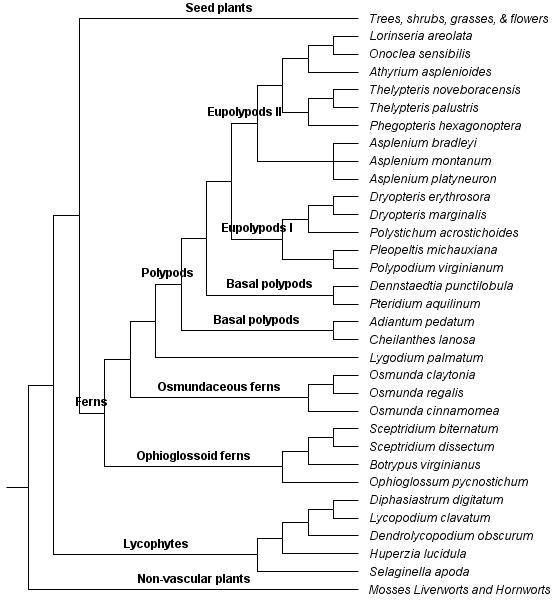
Relationships are based on published phylogenies. Relative branch lengths are not meaningful.