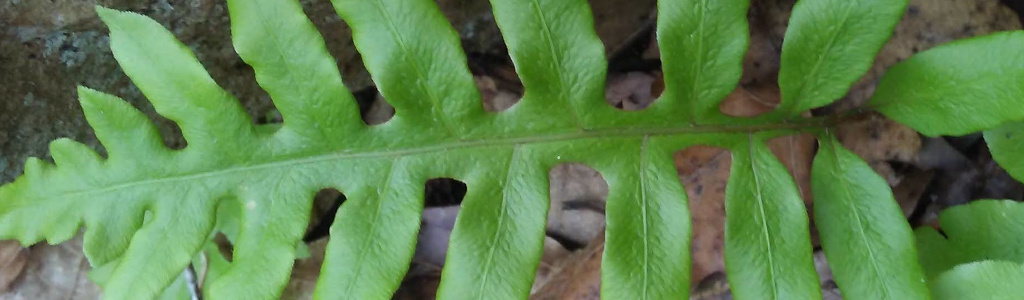
 This project began in 2019 as an effort to learn the fern flora of the state park near my home—Eno River State Park. After contacting park staff and learning that no up-to-date, comprehensive, consolidated checklist existed, I began compiling records from herbarium data, state park records, and iNaturalist field observations, while systematically searching for each reported species to verify its presence.
Over time the scope expanded to include Occoneechee Mountain State Natural Area, a nearby site with distinct geology and habitat structure. Together, these two areas provide a range of substrate, elevation, and moisture regimes, supporting different plant species. The long-term goal is to extend this effort to additional protected areas across North Carolina, building a set of comparable, site-specific inventories that document the regional diversity of seed-free vascular plants.
Why Ferns and Lycophytes?
Ferns and lycophytes are the two major lineages of seed-free vascular plants. Like all vascular plants, they possess specialized conducting tissues (xylem and phloem) that transport water and nutrients. This distinguishes them from bryophytes (mosses, liverworts, and hornworts), which lack true vascular systems. At the same time, they differ from seed plants (gymnosperms and angiosperms) in their reproductive mode. Rather than producing seeds, they reproduce via spores and have a life cycle of alternating generations, with independent sporophyte and gametophyte stages.
In North Carolina, these groups are represented by a relatively small number of species, making learning them all a manageable task, and most species can be identified reliably in the field without the use of a microscope.
What are Ferns?
The ferns are a lineage of vascular plants with megaphyllous leaves (fronds), circinate vernation (the coiled “fiddlehead” stage), and spore-producing sporangia typically on the underside or margins of the fronds. Most ferns share a life-cycle in which a free-living, photosynthetic gametophytes produce gametes that require water for fertilization.
Phylogenetically, ferns are the sister group to seed plants. They represent a diverse lineage with growth forms ranging from small terrestrial species to epiphytes and, in tropical regions, tree ferns.
What are Lycophytes?
Lycophytes are an ancient lineage of vascular plants that includes clubmosses, spikemosses, and quillworts. They differ from ferns in their microphylls—small leaves with a single unbranched vein. Without fronds to support their spore-bearing structures, their sporangia are clustered into cone-like strobili.
Historically, lycophytes were grouped with ferns under the informal term “fern allies.” This terminology is no longer used in modern systematics because it doesn’t reflect evolutionary relationships. Lycophytes diverged early in vascular plant evolution and are not especially closely related to ferns. In fact, ferns are more closely related to seed plants than they are to lycophytes.
Who put this together?
 My name is Aaron M. Duffy and I am a PhD-trained biologist with a background in evolutionary biology and science education. My research experience at Duke University and Utah State University has included studies of seed-free plants like ferns and mosses. I am fascinated by their cryptic gametophytes and alternating generations and I can frequently be found peering into rock crevices with a flashlight, looking for hidden ferns. My broader interests include plant diversity, systematics, speciation, and using hands-on inquiry activities to improve the way we teach science.
How can I contribute to this project?
Citizen science projects like iNaturalist allow users to document plant diversity with georeferenced photos that can be reviewed and identified by a broader community. Repeated observations help improve knowledge of species distributions and habitat associations, so even common species are valuable to document.
Additional contributions include supporting local conservation groups, participating in field-based learning, and visiting protected areas throughout North Carolina. Increased engagement at these sites contributes indirectly to their preservation and to the collective understanding of their biodiversity.
Where can I learn more?
Books
- A Natural History of Ferns – Robbin C. Moran
- Fern Finder – Barbara Hallowell
- Ferns of the Coastal Plain – Lin Dunbar
- Ferns of the Smokies – Murray Evans
- Peterson Field Guide to Ferns: Northeastern and Central North America – Boughton Cobb, Cheryl Lowe, Elizabeth Farnsworth
Organizations and Resources
- iNaturalist
- Eno River Association
- American Fern Society
- NC State Parks Vascular Plants of North Carolina
- Flora of the Southeastern United States